By Lisa Bian and Sean Tseng
January 31, 2023 Updated: January 31, 2023
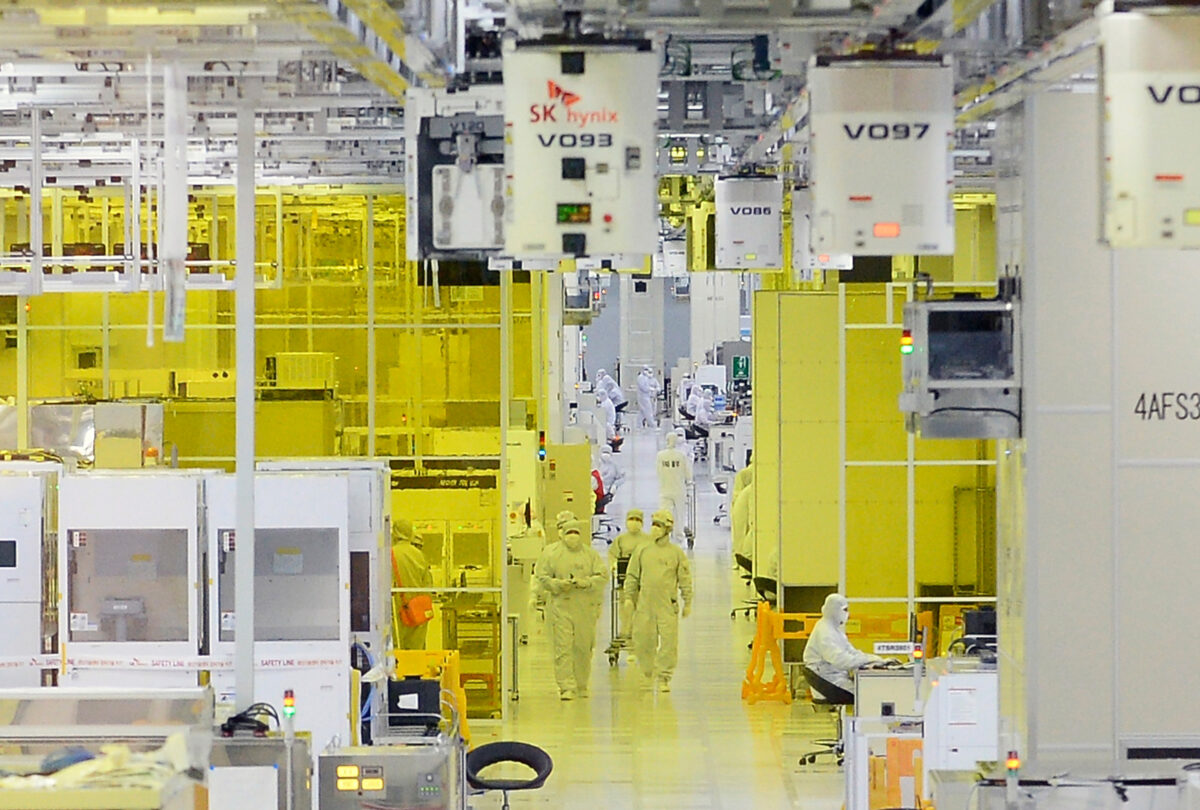
Workers work at SK HYNIX Inc. plant on August 25, 2015 in Icheon, South Korea. (Kim Min-Hee-Pool/Getty Images
Six South Korean
nationals were indicted for leaking the country’s national core technology to
China. The stolen technologies pertain to the Chemical Mechanical Polishing
(CMP) used in manufacturing semiconductor wafers.
The Technology and Design
Police Division of the Korean Intellectual Property Office (KIPO) and the
Daejeon District Prosecutors’ Office said on Jan. 26 that they arrested three
people and charged three others without detention for violating the Industrial
Technology Protection Act and the Unfair Competition Prevention Act, Yonhap News Agency reported.
All the individuals on
trial are former and current employees of three unnamed South Korean tech firms
with critical technologies to the country’s semiconductor value chain.
According to the KIPO,
one of the defendants—referred to as “Mr. A”—was suspected of accessing
confidential data by connecting to the company’s internal network with a
computer and a business cell phone, filming them using his personal mobile
device, and leaking them to a Chinese firm. The leaked data reportedly
contained many cutting-edge technologies and trade secrets related to
semiconductor wafer polishing.
After reportedly being
turned down for a promotion to a high-level post at the company in 2018, Mr. A,
the alleged primary culprit, agreed to work with a Chinese company on
semiconductor wafer polishing in June 2019.
While continuing to work
at the South Korean firm, he helped the Chinese firm establish a production
base and manage the business remotely through various communication apps.
Mr. A then poached three
researchers from other South Korean tech companies to the firm in China and
gave them positions as vice president, team leader, and team member in
September 2019. He later moved to China in May 2020 and served as the firm’s
president.
The annual salary each of
them received in the Chinese firm was reportedly 2 to 3
times their prior salaries. Meanwhile, they were also given various forms of
preferential treatment in China.
Korean authorities also
found leaked confidential business information of two other Korean firms, along
with leaked information on where Mr. A had worked.
According to a KIPO
official, among the three companies affected, the estimated damage to the firm
with the smallest loss due to the leak was more than 100 billion won (about $8
million).
The three unnamed Korean
firms affected by the leak are domestically listed companies that manufacture
memory semiconductors or semiconductor material parts, such as chemical
mechanical polishing fluids and pads. They reportedly have a total market capitalization
of 66 trillion won (about $5.3 billion).
Kim Si-hyung, director of
KIPO’s Industrial Property Protection Bureau, said the bureau would “further strengthen
the role of the Technology Police and take the lead in protecting national core
technologies.” Meanwhile, it would “make every effort to provide reemployment
opportunities and fundamentally eradicate technology-related crimes.”
China has long been
criticized for stealing advanced technologies from countries worldwide,
and South Korea, one of the world’s leading
semiconductor powerhouses, has been a frequent target of Chinese industrial
technology theft.
Frequent Target of IP Theft, Most Related to
China
According to The Korea Herald, the country’s National
Intelligence Service has detected a total of 99 cases of attempted industrial
espionage over the past five years, which would have cost domestic companies
about 22 trillion won ($18 billion).
Technologies and trade
secrets targeted in the 99 cases from January 2017 to February 2022 involved
display devices (19 cases), semiconductors (17), electric and electronic
products (17), automobiles (9), shipbuilding (8), information and
communications (8), and machinery (8), the report said, citing the intelligence
agency.
In recent years, leaks of
South Korea’s cutting-edge technologies have frequently appeared in the news,
with most related to Chinese intellectual property theft.
On Oct. 27, South Korean
prosecutors indicted four
current and former Samsung employees for stealing proprietary
semiconductor technology from the Korean conglomerate and leaking them to
overseas firms.
Two of the employees are
former engineers, while the other two were still employed as researchers for
Samsung Engineering at the time of reporting.
The stolen technology
pertains to the highly valued ultrapure water system used in chip fabrication
and other key technical data. Since 2006, Samsung Electronics has reportedly
invested more than $21 million annually to develop its ultrapure water systems.
One former employee
reportedly acquired an operation manual and a blueprint for an ultrapure water
system and other key technology data from two Samsung engineers and leaked the
documents to a Chinese semiconductor consulting firm, where he was looking to job
hop at the time.
In December last year,
four South Korean nationals were charged for
allegedly leaking cutting-edge semiconductor technologies to a Chinese company.
According to Korean
newspaper JoongAng Ilbo, an unnamed South Korean company illegally obtained the
sensitive technology from another South Korean company and then sold it on to a
newly established semiconductor company in China.
The stolen technology is
a design drawing of a “Hot Zone,” said to be cutting-edge equipment for
manufacturing semiconductor chips that the South Korean company invested
significant time and capital in creating.
In May last year, South
Korean prosecutors indicted two former researchers of SEMES, a Samsung
Electronics subsidiary and semiconductor-related supplier, and two other
employees of a supplier of SEMES for their alleged involvement in technology theft.
The theft involved
selling crucial “wafer cleaning machines” to an undisclosed Chinese entity,
according to Suwon District Public Prosecutors’ Office.
The machines are used in
the early stage of chipmaking when it is crucial to keep the chip wafers clean.
Later stages would require a more sophisticated approach. The equipment uses
carbon dioxide in a supercritical fluid state to clean the wafer compared with
cleaning with other fluids like ultrapure water.
Experts: ‘More Protection of Intellectual Property Rights Needed’
The Federation of Korean
Industries on Oct. 27 released a survey
it conducted on 26 industry security experts. About 85 percent of the
respondents said that the level of South Korea’s protection of its advanced
technology was weaker than that of the United States, while the country’s
R&D capabilities are on par with its rival nations.
Based on the experts’
estimates, the report said the average annual damage caused by industrial
technology leaks, including overseas leaks, is about $40 billion, equivalent to
2.7 percent of South Korea’s GDP in 2021 and 60.4 percent of the country’s total
R&D expenditure in 2020.
Meanwhile, 92.3 percent
of the experts believe that China is the country that South Korea should be
most wary of regarding leaks, while 7.7 percent believe it is the United
States.
South Korea ranked third among
63 countries in “science infrastructure” in the 2022 national competitiveness
ranking released in June by Switzerland’s International Institute for
Management Development. However, it was ranked 37th for protection of intellectual property rights.
Yu Hwan-ik, chief of the
Federation’s industrial research division, said that “Korea is
at great risk of losing core technologies and human resources as a highly
competitive country in cutting-edge technologies.”
He added that “the
society needs to raise awareness as a whole and make institutional
improvements.”
No comments:
Post a Comment